
Grow a Garden Calculator
Select Calculator
Grow a Garden Calculator Complete Guide to Using Soil, Mulch, Raised Bed, Zone & Fertilizer Tools
Gardening becomes easier and more efficient when you use accurate measurements. The Grow a Garden Calculator combines five essential tools Soil, Mulch, Planting Zone, Raised Bed, and Fertilizer calculators into one simple interface. Each calculator in this tool is designed to help you plan your garden correctly, save resources, and boost plant growth.
This article explains how each calculator works, the formulas used inside your code, and real examples so users understand the tool before using it.
How Our Grow a Garden Calculator Works
Before you start using any tool, you must choose one calculator from the “Select Calculator” menu. Each button opens a separate section and hides the others. This keeps the page clean and easy to use.
Once the calculator appears, enter the required values and press Calculate. The tool then uses built-in JavaScript formulas to give instant results.

Soil Calculator
The Soil Calculator helps you determine how much soil you need for a specific garden area. Whether you are filling a garden bed or preparing a new planting space, knowing the correct soil volume saves time and money.
How the Soil Calculator Works
Your soil calculator uses a simple formula:
Formula Used:
Soil Needed = Garden Size × 0.5
This means for every square foot of garden area, the tool assumes half a cubic foot of soil is required. This measurement is ideal for surface-level garden beds or medium-depth fill requirements.

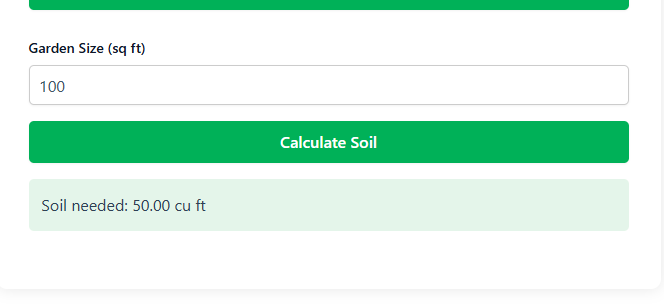
Example of Soil Calculation
If your garden bed is:
Size: 100 sq ft
Then:
Soil Needed = 100 × 0.5 = 50 cu ft
The calculator will display:
Soil needed: 50 cu ft
This helps gardeners buy the correct amount without overpaying for extra soil.
Mulch Calculator
Mulching is important for controlling weeds, improving moisture retention, and maintaining soil temperature. Your Mulch Calculator estimates the exact amount of mulch needed based on the area.
How the Mulch Calculator Works
Your code uses this calculation:
Formula Used:
Mulch Needed = Garden Size × 0.1
This calculation assumes a light mulch layer, ideal for flower beds and newly prepared areas.
Example of Mulch Calculation
If your garden area is:
Size: 150 sq ft
Then:
Mulch Needed = 150 × 0.1 = 15 cu ft
The calculator will display:
Mulch needed: 15 cu ft
This ensures you buy the correct amount of mulch without wastage.
How the Planting Zone Calculator Works
Your tool uses average sunlight hours per day to determine ideal plant types.
Logic Used:
| Sunlight Hours | Recommended Plants |
|---|---|
| 6+ hours | Sun-loving plants |
| 4–5 hours | Partial shade plants |
| 0–3 hours | Shade-tolerant plants |
The calculator identifies the category and displays the correct recommendation.
Example of Planting Zone Calculation
Sunlight: 7 hours/day – Suitable for sun-loving plants
Gardens receiving seven hours of daily sunlight create ideal conditions for sun-loving plants. Such exposure supports strong growth, vibrant blooms, and healthy fruit production, making it perfect for vegetables, herbs, and flowering species.
Sunlight: 3 hours/day – Suitable for shade-tolerant plants
With only three hours of sunlight each day, the garden becomes ideal for shade-tolerant plants. These species thrive in low-light environments, maintaining steady growth, healthy foliage, and consistent performance throughout the season.
Sunlight: 5 hours/day – Suitable for partial-shade plants
Five hours of sunlight daily provides a balanced environment for partial-shade plants. This moderate light level supports steady growth, preventing overheating while ensuring plants receive enough energy for healthy foliage, flowering, and overall productivity.
Raised Bed Calculator
Raised beds are popular for vegetables, herbs, and small gardens. To fill a raised bed correctly, you need to calculate the exact volume of soil required.
Your Raised Bed Calculator makes this process easy.
How the Raised Bed Calculator Works
Your formula is based on the volume of a rectangular box:
Formula Used:
Volume = Length × Width × Depth
This gives the soil volume in cubic feet.
Example of Raised Bed Calculation
Suppose your raised bed is:
Length: 6 ft
Width: 3 ft
Depth: 1 ft
Then:
Volume = 6 × 3 × 1 = 18 cu ft
The tool will display:
Raised bed volume: 18 cu ft
This helps gardeners purchase the exact quantity of soil mix.
Fertilizer Calculator
Fertilizer requirements vary by plant type. Your Fertilizer Calculator estimates how much fertilizer is needed based on the number of plants and the selected plant type.
How the Fertilizer Calculator Works
Your calculator uses preset fertilizer needs for each plant:
| Plant Type | Fertilizer Needed (lbs per plant) |
|---|---|
| Tomato | 0.2 lbs |
| Carrot | 0.1 lbs |
| Basil | 0.15 lbs |
| Marigold | 0.1 lbs |
Formula Used:
Total Fertilizer = Number of Plants × Fertilizer per Plant
Example of Fertilizer Calculation
If you select:
Plant Type: Tomato
Number of Plants: 20
Then:
Total Fertilizer = 20 × 0.2 = 4 lbs
The result will show:
Fertilizer needed: 4 lbs
This helps gardeners avoid over-fertilizing, which can harm plants.
Conclusion
The Grow a Garden Calculator is a practical, user-friendly tool that helps gardeners plan effectively and calculate essential materials with precision. From soil and mulch to plant types and fertilizer amounts, each calculator makes gardening smarter and more efficient. By understanding the formulas and examples provided above, users can confidently use the tool and get the most reliable results.
FAQ's
How accurate are the soil and mulch calculations?
The calculations are based on standard gardening depth estimates. The Soil Calculator assumes 0.5 cubic feet of soil per square foot, while the Mulch Calculator uses 0.1 cubic feet. These formulas provide reliable estimates for most garden beds.
Can beginners use the Planting Zone Calculator?
Yes. The Planting Zone Calculator is designed for beginners. You only enter average sunlight hours, and the tool instantly tells you whether your plants should be sun-loving, partial shade, or shade-tolerant.
What measurements do I need for the Raised Bed Calculator?
You must enter the length, width, and depth of your raised bed in feet. The calculator multiplies these values to determine total soil volume in cubic feet.
How does the Fertilizer Calculator decide fertilizer requirements?
It uses preset fertilizer amounts for each plant type. You enter the number of plants and select the plant type. The tool multiplies both values to calculate the total fertilizer needed.
Can these calculators be used for any garden size?
Absolutely. The calculators work for small home gardens, large backyard beds, raised beds, and container gardens. Simply enter your garden dimensions, and the tool provides accurate results regardless of size.